Golden evening over the Aegean: merchant ships sail toward a harbour town beneath a clifftop sanctuary, where smoke rises from an altar.

The World

Hellas, two centuries after Troy

Real Greece is the skeleton of this world. Myth is not a second map: it belongs to places — to a spring, a pass, a harbour, a mountain.

Atlas

An atlas of the Age of Mortals

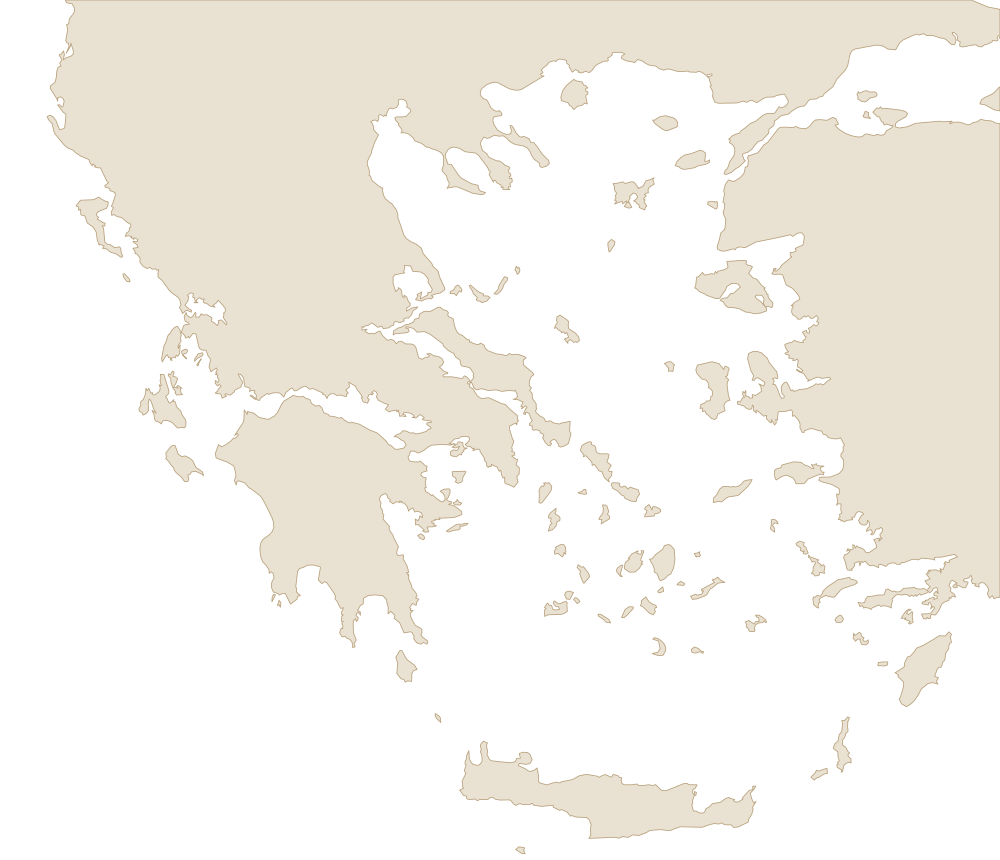
Mountains divide the land; the sea connects it. Select a place to read what travellers say of it.

Phocis · Parnassus

Delphi

The oracle — and the archive of every covenant sworn since the heroes.

Authority without a throne →

No map is complete. This one shows what travellers agree on.

Six places

Where the age is being decided

The Acropolis of Athens at late afternoon: Cyclopean walls and an early temple of Athena above the lower town, with the gulf glinting in the distance and an owl on an olive branch.

01 Attica

Athens

City and sea

Athens is no longer a royal citadel, and not yet anything its future will be proud of. It has drawn the villages of Attica into one city while each still keeps its own shrines, and its harbour grows faster than anyone planned.

Athena watches over the city. She does not govern it. The sea beyond the harbour was promised long ago, to someone older than the city.

“The goddess gave us the olive. The sea we were only allowed to use.”
— Attic saying
The citadel of Thebes on a low hill above a golden plain, its old walls and gates lit by evening sun, with Mount Cithaeron dark behind.

02 Boeotia

Thebes

Fertile plain, heavy memory

Seven gates, a citadel older than its songs, and a plain that feeds half of central Greece. Thebes is the strongest city of Boeotia — but Boeotia is a region before it is a state.

Every city of the plain claims a share of the old stories. Fewer agree on who speaks for them now.

“Beneath the wheat lie kings. We plough around them.”
— Boeotian farmers
The sanctuary of Delphi beneath the shining cliffs of Parnassus at morning, the temple of Apollo above a winding sacred way, pale vapour rising beside it.

03 Phocis · Parnassus

Delphi

Authority without a throne

Pilgrims climb the Sacred Way with questions; envoys climb it with grievances. Delphi answers neither with an army. It keeps the oracle, and it keeps the records of the oaths that hold the Greek world together.

Its authority is old and real. Its sovereignty is none. Lately, the archive is consulted more than it is believed.

“A prophecy can be true without being whole.”
— Delphic teaching
The Isthmus of Corinth from above: two seas busy with ships, oxen hauling a ship across a paved trackway, the city and the rock of Acrocorinth beyond.

04 The Isthmus

Corinth

The hinge of Hellas

Ships are hauled across the isthmus on a paved road, from one sea to the other, and Corinth takes its share of every cargo. It is powerful because it controls passage and exchange — not because it rules anyone.

Wealth below, survival above: on the great rock of Acrocorinth, the city keeps its last refuge and its oldest altars.

“At Corinth, even the gods pay the toll.”
— Sailors’ joke, not recommended at the altar
The Argive plain seen from the Cyclopean walls of Mycenae, with the carved lion gate in shadow and the still marshes of Lerna glittering on the coast.

05 Argos · Mycenae · Lerna

The Argolid

The old royal heartland

The lion gate of Mycenae still stands over a plain of olives and wheat. Argos rules it now, with kings who are real and limited, bound by their communities and by what the land already owes.

On the coast, the marshes of Lerna are quiet. They have been kept quiet for generations, and keeping them so is not cheap.

“We did not inherit Argos’s crown alone. We inherited its duties.”
— Words attributed to an Argive king
A Greek ship under a square sail crossing a deep blue sea between rocky islands, dolphins at the bow and a still, dark squall on the far horizon.

06 Islands and sea-roads

The Aegean

The sea that connects

Islands step across the water from Hellas to Asia. Every harbour has a shrine and every crossing has a price, paid in silver, in prayer, or in knowing which winds to fear.

Sailors say the sea is never empty. They mean it literally.

“Maritime knowledge is kept by those who came back.”
— Harbour proverb

Mythic Peoples

The wild is old, inhabited and has its own laws

The Age of Mortals is not a human world alone. Some who share it are peoples; some are singular, ancient and best left unnamed.

A sunlit spring in an old forest on Mount Pelion: a rustic shrine hung with ribbons, a centaur standing still among the white pines, and in the pool the reflection of a woman who is not there.
Centaurs
Not one nation but many clans, on Pelion and beyond, bound to their human neighbours by old accords.
Nymphs
Bound to a spring, a river, a mountain or a grove. To foul the water is to answer to someone.
Satyrs and Silens
Wild bands on the edge of the vineyards — close to Dionysus, and nobody’s servants.
The Nereids
Daughters of the old sea, few and divine. There is no nation beneath the waves.
Remnants
The Hydra, the Chimera, the Minotaur and the Sphinx are dead. What they left behind is guarded, not forgotten.